
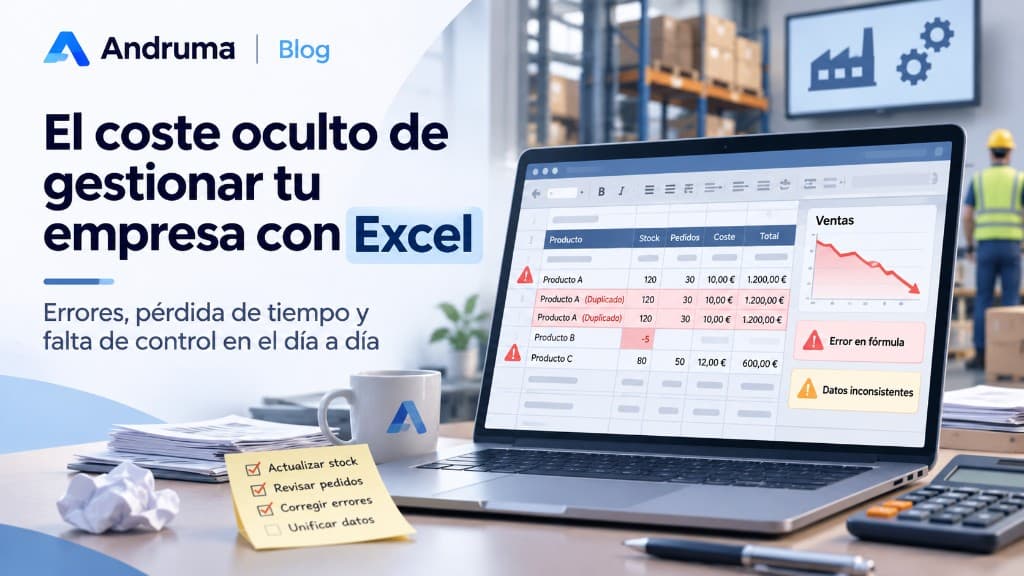
Picking the wrong cell in a spreadsheet had an impact of around 86 million euros. It was not a cyber attack or a sophisticated failure: it was a human mistake in a process that relied on Excel. The case is real. In 2023, the manager of Norway's sovereign wealth fund (Norges Bank Investment Management, NBIM) acknowledged a deviation in trade execution linked to a wrong input taken from a spreadsheet. Published figures are about 980 million Norwegian kroner, roughly 86 million euros at typical exchange rates quoted in Spanish business media.
This was not cash stolen from a vault. It was an opportunity cost and a deviation from the benchmark index because trades ran with incorrect weights. The lesson for any company still stands: when one wrong figure can move huge amounts, it is worth asking what happens in everyday spreadsheets.
What happened in Norway
NBIM runs one of the world's largest investment funds. Its 2023 annual report explains that during rebalancing an employee used the wrong cell in a spreadsheet when preparing data for trades. That mistake led to buys and sells with weights that did not match the intended benchmark.
The fund put the impact at about 980 million kroner. Outlets such as Xataka covered the story in 2024. For the mechanism and figures, see NBIM's 2023 annual report.
How a small mistake scales up
In a sovereign fund one decimal shifts enormous volume. In an industrial SME the amounts are smaller but the pattern repeats. How many Excel files does your team open each day? What if someone changes a figure unnoticed? Do all departments share up-to-date information?
Five common risks when Excel runs the business
- Duplicate data across workbooks.
- Copy-paste errors between departments.
- Accidentally changed formulas.
- Outdated file versions.
- No audit trail of who changed what.
Hypothetical example (not a real andruma client)
Before
- Order received
- Sales spreadsheet
- Copy data
- Update stock manually
- Tell production
After (centralised model)
- Order received
- Central record
- Validation
- Status updates
- Shared information
Controls and when Excel is not enough
Permissions, a single master file per process and cross-checks reduce risk before you talk about an ERP. When reconciliation meetings grow and every new reference needs another patch, it may be time to look at custom software or a custom ERP to centralise data, permissions and traceability. An ERP does not remove every error; it can stop a critical figure living in fifteen unsynchronised copies.
The problem is not using Excel. It is relying on it to run the whole company.
If orders, warehouse and production depend on separate files, we can help you explore a system shaped around your processes.