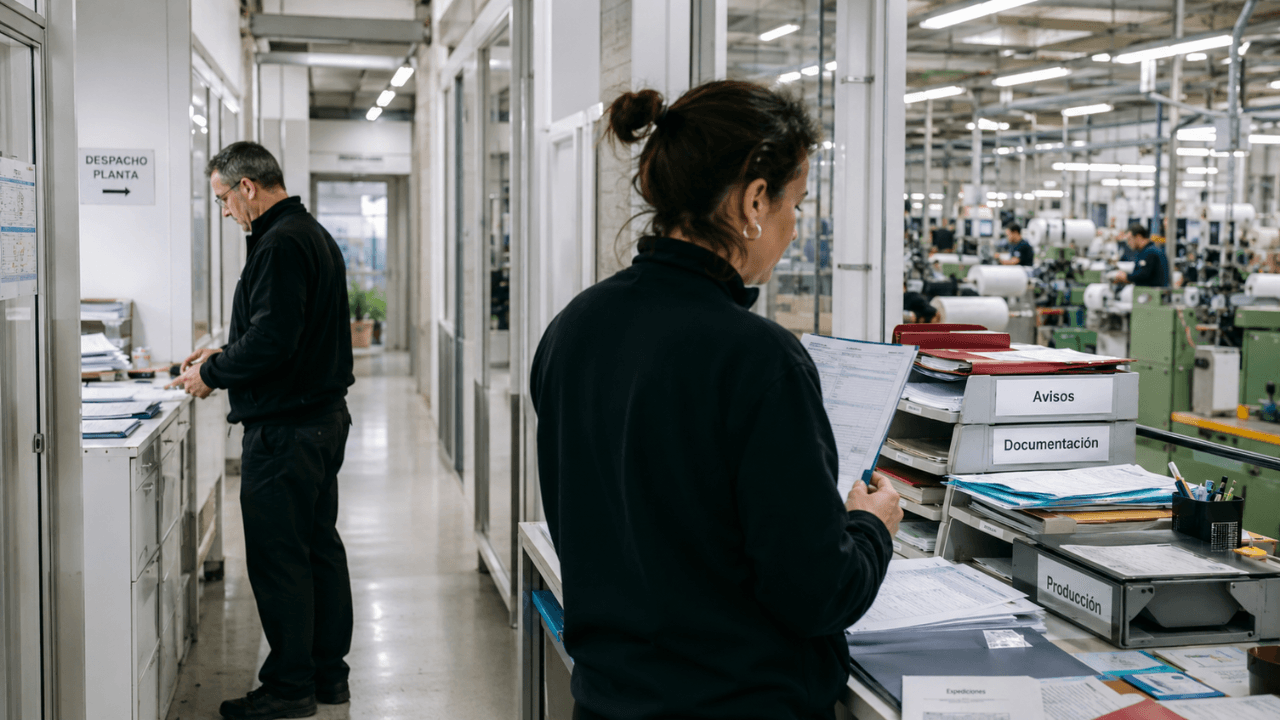

Documentation arriving through every channel
A Catalan industrial company, based in the Barcelona area, received a steady flow of documents every day: supplier delivery notes, material certificates, customer orders in different formats, and internal questions about lead times and part numbers. Some arrived scanned, some by email, and some through B2B portals with mixed attachments. The administration team classified each document and passed it on by hand before it could affect purchasing, planning or invoicing.
Management was not trying to replace production processes that already worked. The aim was to cut repetitive back-office work, and to stop frequent questions (stock of a part number, status of an order, history with a supplier) from always depending on interrupting the one person who knows where everything is filed. Artificial intelligence came up as a possible tool for classifying and extracting information from documents and from internal history the company already held.
The work of opening, reading and filing
The main bottleneck was taking documents in and classifying them. Each delivery note or order had to be identified by type, customer or supplier, the part numbers involved and the destination department before anyone could act in the system. Formats varied: a scanned PDF, a spreadsheet with different columns depending on the sender, an image sent by instant message. Classification errors caused delays that were hard to spot until someone asked for the document in a quality review or an internal audit.
Questions that always interrupted the same role
Operators, sales staff and shop-floor managers asked the same things in different words: whether material was available, the expected delivery date, where a signed document was. Answering meant looking in several systems, or asking the person who kept the figure in their head. The information was there. The friction was in reaching it. The company needed to automate low-value tasks without touching the core logic of manufacturing.
Queues at the end of the day, and decisions on incomplete information
Documents waiting to be classified piled up at the end of the day. Purchasing released orders late because the delivery note was not yet on the system. Planning checked stock while administration was still keying receipts of the same material. At busy points (month-end, container arrivals, sales campaigns) the delay in the paperwork turned into urgent jobs and rework. The cost showed up as overtime, tension between departments, and decisions taken on incomplete information.
Relying on people who knew where to look limited everyone else. New joiners took weeks to understand the informal logic of the files and the exceptions. Taking on more staff only to move paper and answer the same questions was not sustainable.
A small project with a clear boundary
A tightly scoped automation project was designed, with artificial intelligence applied to one front only: classifying incoming documents and routing them. No robots on the line, and no forecasts of demand. The point was to reduce the work of opening, reading and filing. The solution was deployed on infrastructure the company controlled, with clear rules for what could be automated and what needed a person to confirm it.
Training on the company's own documents
A model trained on real, anonymised examples learned to recognise document types (delivery note, order, certificate, change notice) and to extract key fields such as part number, quantity, supplier or batch number. An operator reviews and confirms in seconds, instead of typing from scratch. When the system's confidence is high, the record can be completed automatically. In ambiguous cases, the decision stays pending an explicit review.
After the first months of stable use, average classification time fell significantly. Queues at the end of the day shrank, and purchasing could book material receipts more quickly. The team valued the assisted review: confirming proposals that were already structured, instead of interpreting each PDF from scratch. Management obtained clear measures (documents processed per day, accuracy rate, cases sent for manual review) so later extensions could be decided on evidence.